KSU Presented Its Experience in Using Digital Tools at an International Conference
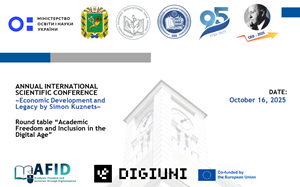
Kherson State University took part in the annual international scientific conference “Economic Development and the Legacy of Simon Kuznets,” initiated by Simon Kuznets Kharkiv National University of Economics.
During the session “Academic Freedom and Inclusion in the Digital Age,” participants presented and discussed the results, ideas, and achievements of the ERASMUS+ projects AFID (Providing of Academic Freedom and Inclusion through Digitalization) and DigiUni (Digital University – Open Ukrainian Initiative).
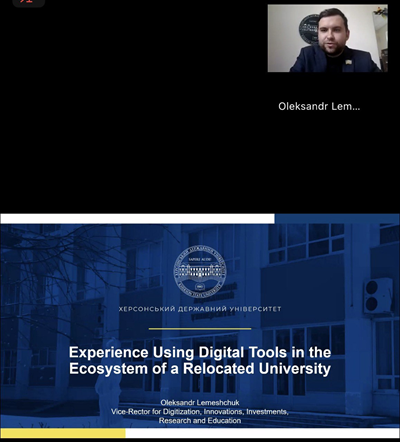
Oleksandr Lemeshchuk, Vice-Rector for Digitalization of Kherson State University, presented the university’s experience in using digital tools within the ecosystem of a relocated institution- of course, using KSU as the example.
Key points of the presentation:
He noted that in 2022, due to russia’s full-scale invasion of Ukraine, the temporary occupation of Kherson, and the university’s forced relocation to Ivano-Frankivsk (based at Vasyl Stefanyk Precarpathian National University), KSU faced an unprecedented challenge — the complete loss of physical infrastructure. This forced a 100% transition into a digital environment.
At that moment, digitalization ceased to be a matter of convenience or innovation. It became an instrument of survival and resilience. The goal was not only to continue the educational process, but also to preserve the university as a community of faculty, students, and staff.
To address this challenge, we did not simply start using individual services. We built a comprehensive digital ecosystem. At the heart of this system is our own development — the KSU24 information platform. It serves as the integration core that connects all processes. The ecosystem includes:
- KSU-online – for the educational process
- Google Workspace and Microsoft 365 – for corporate communication
- Zoom – for online events
- A specialized video laboratory for producing educational content
This approach is fundamentally different from what we had before. Until 2021, we used a local system developed back in 1997, which was designed primarily for administrative purposes.
Today, KSU24 is a unified cloud platform, available 24/7 and integrated with all key services, including EDEBO and Diia. We have shifted from a closed, administration-focused system to an open ecosystem with the student at its core.
The KSU24 platform has become a single entry point for all participants in the educational process. It automates key functions:
- Gradebooks: all grades, pass/fail records, and exams are now online, paper-free, and accessible to both students and lecturers at any time.
- Digital document workflow: documents can be submitted and signed online, without queues or delays, from anywhere.
- Structure and HR management: all administrative activities — from unit structures to position management — are handled within a unified environment. This digital infrastructure is what keeps the university fully operational, even when we do not have a physical campus.
Beyond administrative processes, we are actively integrating digital tools directly into teaching. We have incorporated AI tools such as ChatGPT, Copilot and Gemini into the educational process.
To help our lecturers feel confident in this new environment, we regularly conduct the “School of Professional Development.” Our aim is not merely to teach how to use software, but to create an environment in which every lecturer can become a digital leader.
Understanding the importance of high-quality content for distance learning, we established a specialized media lab. Here, we record lectures, video courses and podcasts. These are more than just learning materials — they help convey the “life” of the university, preserving the connection and energy of our community, even at a distance.
At the management level, we have fully transitioned to electronic document workflow within the Rectorate and rely on analytical dashboards for decision-making. All HR orders and leave records are stored in KSU24. Our principle is simple: “less paper — more data.” This has made governance transparent, fast, and—most importantly—based on real evidence.
Despite the challenges, relocation has not isolated us. On the contrary, it has pushed us toward greater integration into the European higher education area. Today we have:
- 6 major international projects, 4 of them Erasmus+.
- Over 40 agreements with universities in the EU, the USA and Canada.
- A total of 36 million UAH in revenue from international activities in 2024–2025.
Of course, the path was not easy. We faced issues with technical infrastructure, unstable connectivity and data security. But the most difficult challenge was the human factor — adapting thousands of students and lecturers to new conditions in a very short time. The key lesson we learned is that digitalization is not only about technology; it is, above all, about a culture of interaction. And our biggest achievement is that we kept our people. We preserved the university as a community.
We are moving forward. Our next phase includes implementing AI, advanced analytics and personalized learning. We plan to develop KSU24 as an Educational Data Hub. Our goal is to make Kherson State University one of the leaders of digital transformation in Ukrainian higher education.
Summing up, Oleksandr Lemeschuk noted:
“Our experience proves that digitalization ensured continuity of education in crisis conditions. KSU has become an example of resilience thanks to rapid and comprehensive digital adaptation. The key factors in this success were our team, the support of our partners and the trust of our community.”
Commenting on the topic of the conference session, Rector of Kherson State University, Oleksandr Spivakovskiy, emphasized:
“The philosophy of the DigiUni project deeply resonates with us. It brings together universities and institutions from Ukraine and EU countries to create an inclusive and high-quality educational platform for students and everyone eager to learn. We are actively involved in developing the platform itself and the courses because we want to provide more educational opportunities for our learners and offer our lecturers the tools to create modern content.
Our own experience, combined with that of our partners and the support of the EU’s Erasmus+ programme, provides a strong foundation for success and for the development of every participant in the DigiUni project and Ukrainian education as a whole.”
The Rector expressed his gratitude to the conference organizers, as well as to the participants for their inspiring presentations and valuable case studies.