How to counter fake AI in the media?
Teachers and students majoring in 061 Journalism at the Department of Ukrainian and Slavic Philology and Journalism of Kherson State University joined the online webinar Artificial Intelligence in Media: Data Journalism, Editorial Policies, and Security.
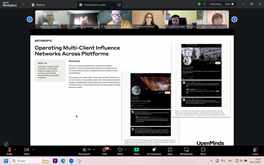
The event was part of the international campaign ‘16 Days Against Gender-Based Violence.’
Kateryna Levchenko, the government's representative on gender policy, said that promoting gender equality is a constant priority for Ukraine. The topic of the webinar was not chosen at random, as women journalists around the world face a double threat: professional risks and threats related to their gender.
As Olga Herasyuk, Chair of the National Council of Ukraine on Television and Radio Broadcasting, noted: ‘We have begun to talk more often about the risks posed by AI and how it affects the safety and rights of each of us.’ The media has become a direct target of cyberattacks, and research confirms that many attacks are aimed at psychological pressure, leading to stress, anxiety and self-censorship.

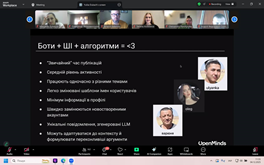
During her presentation on ‘Algorithms of Hate: How AI Bots Promote Their Narratives and Change the Tone of Online Discussions,’ Yulia Dukach (OpenMinds) explained that bots are robotic algorithms that use AI for content scraping, advertising fraud, and spam. The key insight for journalists is that you should never argue with a bot, as this only gives it a perfect platform to promote its arguments and, in particular, Russian narratives.
AI technology is developing very quickly. The programme actually opens an account, manages it, creates unique content, reposts and responds to comments. This is the transition from conventional comment generators to agent-based AI. Full-fledged trolling works around the clock, faster and cheaper than a human, and most importantly, there is no software for automated detection of this level of bots.
The next report was devoted to the development of editorial policy on the use of AI, presented by Tetiana Avdeeva, senior lawyer at the Digital Security Lab. She explained that policy is not just a document on a website, but a fundamental thing and communication that declares the editorial approach to an external audience, while instructions are a flexible, working document for a specific tool.

The speaker emphasised the main question: Will the introduction of AI place a greater burden on employees? After all, you need to write prompts, check data and sources, and rewrite everything yourself.
‘In 5-10 years, we will not have mid-level and senior specialists who will drive our editorial office towards new goals. Because these are the people we are training now. Our interest is in training young journalists,’ said Tetiana Avdeeva.
Among the key recommendations for editorial offices were: defining ‘red lines’ (what cannot be generated), developing a unified system for labelling everything that contains AI elements, even if it is a small fragment of text, and appointing a person responsible for administering these processes.
The webinar was concluded by Serhiy Mikhalkov, data analyst at TEXTY.ORG.UA, who shared his team's experience in exposing how AI and TikTok create fake images of well-known Ukrainian journalists. Therefore, students should learn how to use verification tools, such as the Hiya Deepfake Voice Detector extension, which helps to detect fake audio.
Participation in such an event is an invaluable experience for KSU students. It is an opportunity to gain a deeper understanding of the modern challenges of the journalism profession, to realise the risks associated with digital technologies, and to see practical ways to overcome them.
The author of the article is Daria Bukaeva, a journalism student at Kherson State University.