On May 19 at 2:00 p.m., as part of Science Week, I.V. Solovtsova conducted a webinar for students on the topic: “Specific Features of Using AI in Language and Literature Education: From Technological Hype to Scientifically Grounded Strategies (Types, Algorithms, and Implementation Examples).”


Today, on May 19 at 2:00 p.m., a scientific and practical seminar entitled “Specific Features of Using AI in Language and Literature Education: From Technological Hype to Scientifically Grounded Strategies (Types, Algorithms, and Implementation Examples)” was held for students of the Faculty of Ukrainian and Foreign Philology, Journalism, and Arts. The event was organized by I.V. Solovtsova, Senior Lecturer at the Oleg Mishukov Department of English Philology and World Literature.
During the seminar, the stages of mastering artificial intelligence in education were discussed in accordance with the hype cycle phases associated with the implementation of emerging technologies. Following a general overview of the current situation and a classification of AI tools, Iryna Volodymyrivna outlined the most pressing issues of today: the development of pedagogical strategies for using AI technologies as a tutor, an “intellectual mirror,” and an epistemic partner in hermeneutic dialogue.
The seminar featured specific examples of prompts for creating interactive flashcards independently designed by instructors. Demonstrations were also given of the process of creating interactive simulators intended to support students’ independent analysis of literary texts while preparing for seminars in the history of world literature.
Both higher education students and invited guests took an active part in the seminar. In particular, Yelyzaveta Nedilko, a student of Group 451, presented her own interactive simulator on the topic “Summer Holidays,” aimed at improving vocabulary and grammar acquisition. She also showcased interactive tasks and image-based flashcards designed to facilitate the learning of irregular verbs by students of general secondary education institutions.
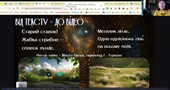
A special highlight of the seminar was the presentation by practicing teacher Anastasiia Serhiivna Krasnovyd, a 2015 graduate of our faculty and a diploma recipient of the second stage of the All-Ukrainian “Teacher of the Year — 2025” competition in the “World Literature” category (Kherson General Education Educational Complex No. 48 of the Kherson City Council). She provided the audience with a detailed explanation of the differences in creating video content using AI tools at the levels of “SUBSTITUTE” — “ASSISTANT” — “CO-AUTHOR.” Anastasiia Serhiivna not only demonstrated the platforms she uses to create visual materials, but also familiarized attendees with the stages of refining generated images and transforming them into dynamic video visualizations.
All participants were provided with links to the demonstrated content as well as ready-made prompt samples. At the end of the meeting, attendees were invited to contribute to the development of new approaches and strategies in which AI in education would be viewed not as a “reducer” or “substitute,” but as an equal participant in a shared hermeneutic dialogue.