Updated: 5/21/2026
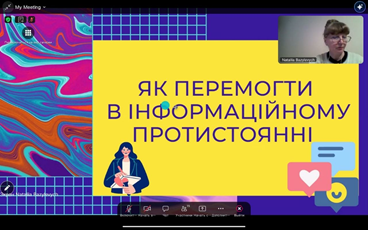
On May 21, 2026, as part of Science Week, the open media event “How to Win the Information Confrontation” was held. The programme offered a comprehensive perspective on the issue, revealing the hidden mechanisms of information threats from various angles.
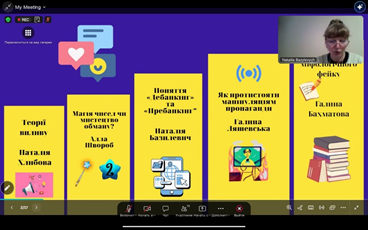
Natalia Khlybova, a Master’s student of group 102M, introduced the audience to the main theories of media influence on public opinion.
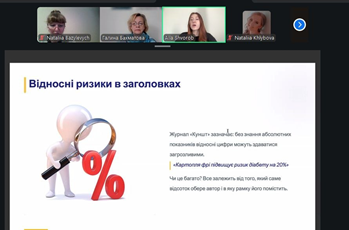
Alla Shvorob, a Master’s student of group 102M, addressed the issue of manipulation through dry figures, statistics, and percentages, which are often used to create an illusion of “objectivity.”
Nataliia Bazylevych, Associate Professor of the Department of English Philology and World Literature named after Professor Oleh Mishukov, acquainted participants with advanced technologies of information hygiene — debunking (fact-checking and refuting fake information) and prebunking (preventive warning and “vaccination” against disinformation).
Halyna Liashevska, a Master’s student of group 111M, member of the National Union of Journalists of Ukraine, speechwriter, and media adviser, shared her practical vision of how to recognise hostile narratives and resist propaganda.
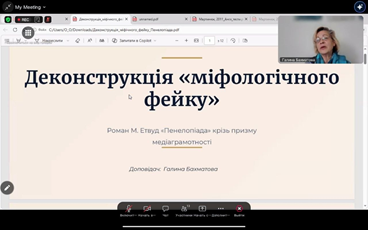
An entirely new perspective on the classics was presented by Halyna Bakhmatova, a Master’s student of group 102, philologist, and literary scholar. She analysed The Penelopiad by Margaret Atwood through the lens of media education, considering it as a tool for reconstructing mythological fake narratives.
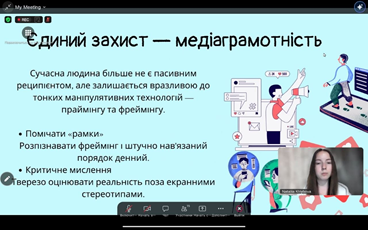
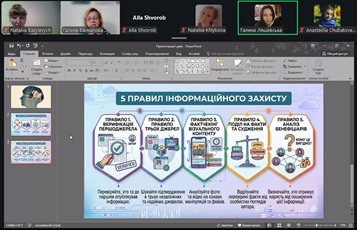
“Information resilience is not about trusting no one. It is about trusting verified information,” the organisers concluded. The key takeaway of the meeting was simple yet vital: whenever news provokes panic or anger, one should pause, activate internal filters, and ask the critical question: “Who benefits from this?” Let us keep a cool head, remain media literate, and protect our information space. Together, we are stronger on every front!
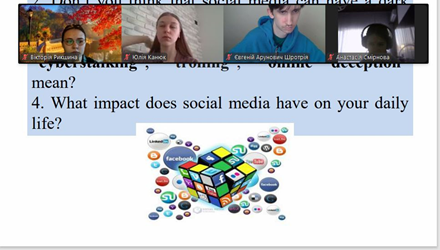
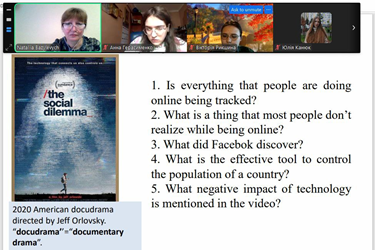
On February 10, 2025, an interactive session “What is on the other side of your screen?” was held for 2nd year students of group 202. During the meeting, participants actively discussed various aspects of the impact of social media on their daily lives. Students also learned how social media platforms and large technology companies can contribute to the spread of disinformation and the polarization of society.



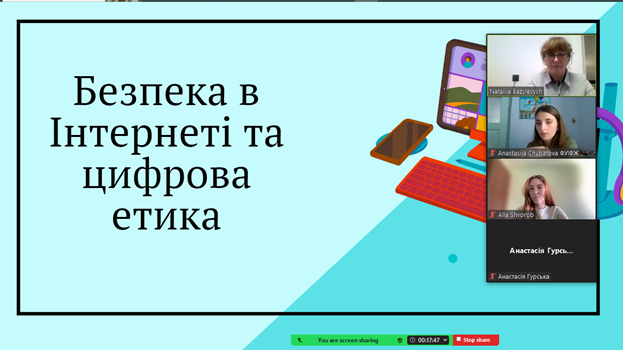
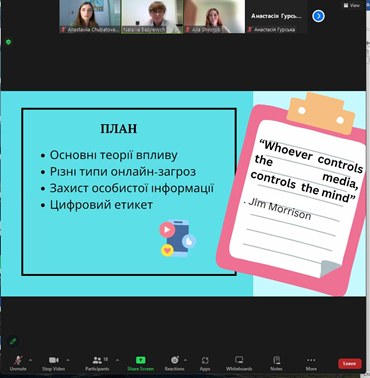
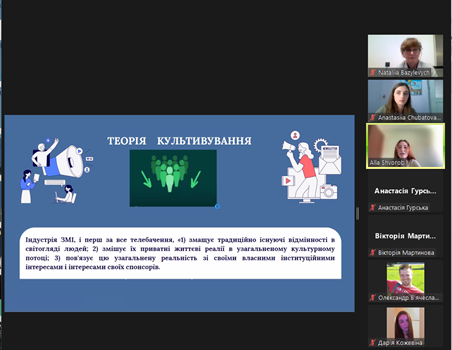
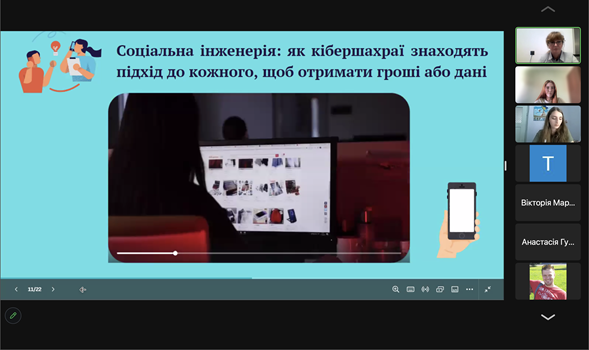
“Let's make the Internet a safe and comfortable space for everyone together” is the slogan of the media event “Internet Safety and Digital Ethics”, which was held by the student science club “Media Education” on 30th May 2024, as part of the KSU Science Days. Third-year students, Anastasia Chubatova and Alla Shvorob, under the supervision of N.V.Bazylevich, associate professor of the Department of English Philology and World Literature named after Professor Oleh Mishukov, introduced the participants of the event to the main theories of the influence of media on our behavior, views and values. The students also talked about how not to become a victim of scammers on the Internet and take care of your privacy in the online environment, and how to use the Internet ethically and responsibly. Participants of the media event had the opportunity to watch short videos in which cybersecurity experts shared useful advice.
For the 2 half of the 2023-2024 academic year the following work was carried out by the Head of the Media Education Student Scientific Club, Nataliia Bazilevich:
- Discussion of the media literacy webinar plan on the topic "How to develop information verification skills"
- Preparation of text materials for the webinar
- Preparation of a presentation for a webinar on media literacy "How to develop information verification skills"
- Conducting an interactive webinar "How to develop information verification skills" in May 2024